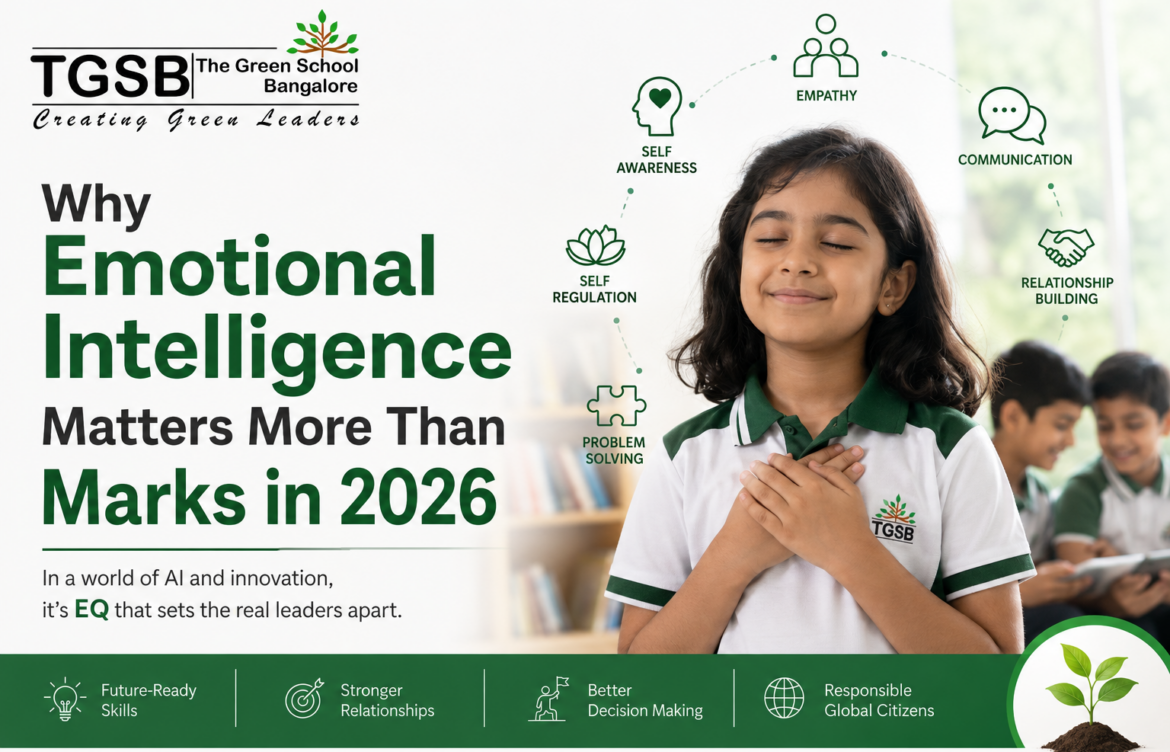
Why Emotional Intelligence Matters More Than Marks in 2026
The Student Who Scored 98% Could Not Handle a Group Project
A teacher recently shared something fascinating.
Two students were given the same task.
One student was academically brilliant. Exceptional grades. Outstanding test scores. The kind of student every report card celebrates.
The other student was average on paper.
The task seemed simple.
Work in a team. Solve a problem. Present a solution.
Within two hours, something unexpected happened.
The high-scoring student became frustrated because teammates disagreed. Feedback felt personal. Different viewpoints felt inefficient. The project became a battle to prove who was right.
Meanwhile, the average-scoring student quietly did something remarkable.
They listened.
They negotiated.
They encouraged quieter voices.
They managed conflict.
They adapted when the plan failed.
The group succeeded largely because of them.
The teacher later made an observation that should make every parent pause.
“Only one of those students was actually prepared for the real world.”
For decades, education has measured what children know.
Increasingly, life rewards how children work with what they know.
And those are not the same thing.
For generations, marks were the currency of success. Good marks opened doors. Good marks created opportunities. Good marks provided a useful signal that a student understood content and could perform well under assessment conditions. There is nothing inherently wrong with marks. The problem begins when marks become the sole definition of competence.
Because the world children are entering in 2026 is fundamentally different from the world their parents entered.
Knowledge has become abundant.
Answers are everywhere.
Information is no longer scarce.
Yet something surprising has happened.
As information became easier to access, human behaviour became more valuable.
Employers increasingly talk about collaboration.
Universities discuss resilience.
Entrepreneurs emphasise adaptability.
Leaders focus on empathy.
Teams succeed because of communication.
Communities thrive because of trust.
Relationships survive because of emotional awareness.
Suddenly, the most valuable human skills are no longer purely cognitive.
They are emotional.
The irony is extraordinary.
The very abilities most likely to determine success in adult life are often the ones least visible on traditional report cards.
A report card can tell you whether a child solved a mathematical equation.
It cannot easily tell you whether the child can navigate disappointment.
A report card can reveal reading ability.
It cannot reveal whether the child can recover after failure.
A report card can show examination performance.
It cannot show whether the child can collaborate with people who think differently.
Yet these capacities shape almost every major life outcome.
Consider a workplace.
Few adults spend their days sitting silently answering questions independently for three hours.
Most adults spend their days communicating, negotiating, presenting ideas, resolving misunderstandings, adapting to uncertainty, responding to feedback, and working with people whose personalities differ dramatically from their own.
Success increasingly depends on emotional intelligence.
Not because emotional intelligence replaces intelligence.
But because emotional intelligence determines how effectively intelligence can be applied.
A brilliant idea delivered without empathy often fails.
Exceptional expertise combined with poor self-awareness often creates conflict.
Knowledge without communication rarely creates impact.
This is why emotional intelligence has quietly become one of the defining educational conversations of our time.
At TGSB, this understanding appears increasingly relevant.
Education is not viewed simply as academic preparation. It is preparation for human life. Children are not only learning mathematics, science, languages, and social studies. They are learning how to understand themselves. How to understand others. How to collaborate. How to listen. How to disagree respectfully. How to persist through difficulty. How to recognise emotions rather than be controlled by them.
These lessons rarely appear as chapters in textbooks.
Yet they may become the most valuable lessons students ever learn.
Perhaps the most dangerous educational myth is the belief that emotional intelligence is soft.
Nothing could be further from the truth.
Managing frustration when a project fails is difficult.
Showing empathy during conflict is difficult.
Receiving criticism without defensiveness is difficult.
Admitting mistakes is difficult.
Leading people is difficult.
Building trust is difficult.
These are not soft skills.
They are human skills.
And increasingly, they are the skills that determine who thrives.
This becomes especially important when considering the future.
Artificial intelligence can process information faster than any human.
Algorithms can retrieve facts instantly.
Machines can perform calculations with extraordinary precision.
But emotional intelligence remains deeply human.
A machine can generate information.
It cannot genuinely care.
A machine can provide answers.
It cannot build trust.
A machine can analyse data.
It cannot create belonging.
The future will not belong to students who merely know more.
The future will belong to students who can connect more.
Who can collaborate more.
Who can adapt more.
Who can understand people more.
Who can remain calm amidst uncertainty.
Who can lead with empathy.
This is why emotional intelligence matters more than marks in 2026.
Not because marks are irrelevant.
But because marks measure only part of what makes a human being successful.
A child may forget a formula.
A child may forget a definition.
A child may forget an examination score.
But the ability to understand themselves, understand others, navigate challenges, build relationships, communicate effectively, and remain resilient will accompany them for life.
Perhaps the question parents need to ask has changed.
Not:
“How many marks did my child get?”
But:
“What kind of person is my child becoming?”
Because in the decades ahead, the greatest competitive advantage may not be knowledge.
It may be humanity.
And humanity has always been the true curriculum.