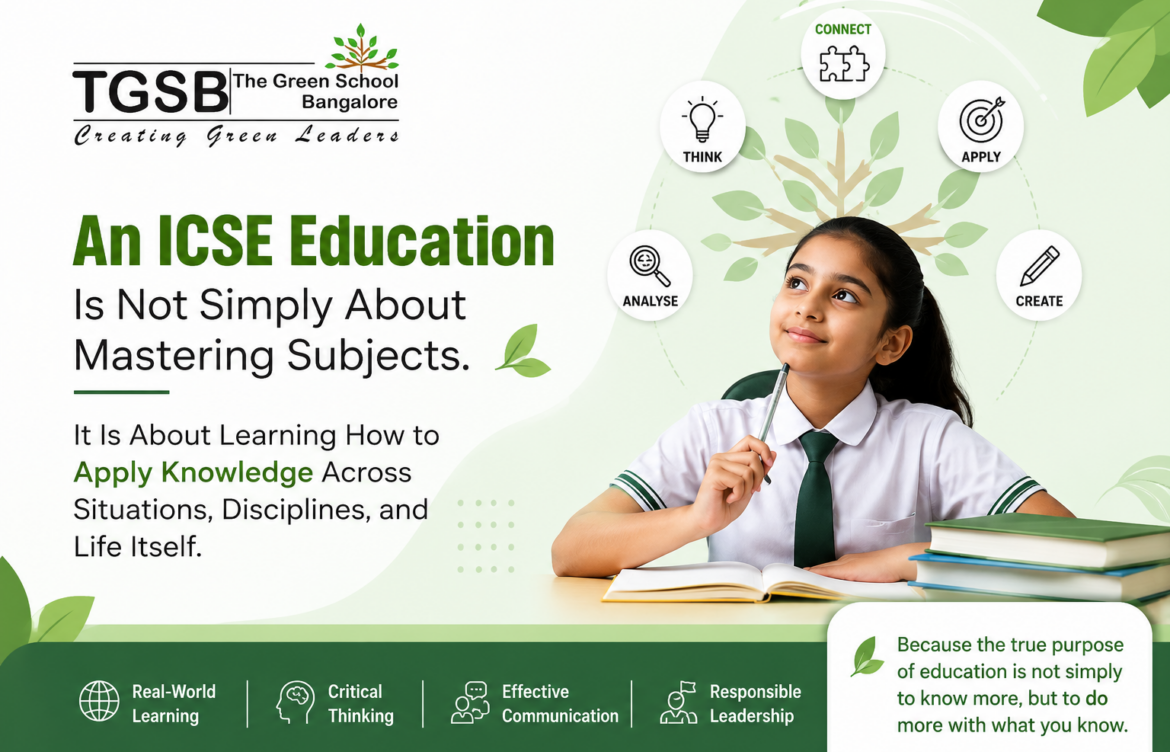
An ICSE Education Is Not Simply About Mastering Subjects. It Is About Learning How to Apply Knowledge Across Situations, Disciplines, and Life Itself.
A few years after leaving best school in bangalore, very few adults are asked to reproduce an answer exactly as it appeared in a textbook. Nobody walks into a workplace and is handed a three-hour examination paper. Nobody enters a meeting and receives marks for memorising definitions. Life asks different questions. It asks people to solve unfamiliar problems, communicate ideas clearly, make decisions with incomplete information, collaborate with individuals who think differently, and adapt when plans do not unfold as expected. This is why one of the most important conversations in education today is not about how much students know, but about what students can do with what they know.
For decades, educational success has largely been viewed through the lens of marks. Marks are important. They provide evidence of understanding, effort, and achievement. They create opportunities and often open doors to future pathways. However, there is a growing recognition among universities, employers, educational researchers, and parents that academic performance alone does not fully capture a learner’s preparedness for life. A student may achieve excellent grades and yet struggle to communicate ideas confidently. Another may possess strong content knowledge but find it difficult to work collaboratively. A third may excel in examinations yet struggle when confronted with uncertainty, ambiguity, or situations where there is no obvious answer. Increasingly, success depends not only on knowledge but also on the ability to transfer knowledge.
This is where the idea of transferable skills becomes so powerful. Transferable skills are abilities that remain useful across different subjects, contexts, careers, and life situations. They are not confined to a single chapter or discipline. They travel. A student who learns to analyse evidence in History is also strengthening analytical thinking that can later be applied in Business Studies, Law, Economics, or scientific inquiry. A student who develops strong writing skills in English is simultaneously learning how to persuade, explain, negotiate, and communicate effectively in future professional and personal contexts. A student who learns how to conduct research develops habits of investigation that remain relevant regardless of whether they eventually become a scientist, entrepreneur, journalist, designer, or policymaker.
One of the strengths often associated with the ICSE curriculum is its emphasis on depth rather than mere coverage. The curriculum encourages students not only to encounter information but to engage with it meaningfully. Students are frequently required to read extensively, write thoughtfully, connect ideas, defend arguments, conduct investigations, and apply learning in varied situations. Such experiences are significant because they move learning beyond memorisation. They encourage students to develop habits of mind that continue to serve them long after the details of a particular lesson have been forgotten.
Consider the way language is approached within the ICSE framework. Many parents initially view English as simply another subject. Yet language proficiency influences nearly every area of life. The ability to read critically allows students to evaluate information more effectively. The ability to write clearly enables them to communicate ideas persuasively. The ability to speak confidently helps them participate in discussions, interviews, presentations, and leadership roles. What begins as language learning gradually becomes confidence building, communication development, and intellectual empowerment. The subject becomes far larger than the syllabus itself.
The same principle applies across disciplines. Mathematics is often viewed as a collection of formulas and procedures. Yet beneath the calculations lies a deeper intellectual training. Mathematics teaches precision, logical reasoning, pattern recognition, structured thinking, and disciplined problem-solving. Science teaches observation, inquiry, experimentation, evidence-based reasoning, and intellectual curiosity. History develops perspective-taking, contextual understanding, and the ability to evaluate competing interpretations. Geography encourages systems thinking and an understanding of interconnectedness. Every subject contains content, but beneath that content lies a collection of cognitive habits that become transferable across life.
At TGSB, this understanding shapes the learning experience in meaningful ways. Education is not viewed merely as the transmission of information. Rather, learning becomes a process through which students are encouraged to think independently, ask meaningful questions, explore multiple perspectives, communicate effectively, and connect classroom learning with real-world contexts. Students are not simply asked to remember. They are challenged to investigate, discuss, analyse, create, and apply. This approach reflects an important educational truth: knowledge becomes powerful only when learners know how to use it.
Perhaps one of the greatest misconceptions about education is the belief that transferable skills emerge automatically. In reality, they must be intentionally cultivated. Confidence develops when students are given opportunities to present ideas and express themselves. Collaboration develops when learners work together to solve authentic problems. Creativity develops when students are encouraged to explore possibilities rather than merely reproduce answers. Adaptability develops when learners encounter challenges that require flexibility and resilience. These experiences do not happen by accident. They emerge through carefully designed learning environments that recognise education as preparation for life rather than preparation for examinations alone.
Parents today face a unique challenge. The world their children will enter is changing rapidly. Careers are evolving. Technology is transforming industries. Information is increasingly accessible. In such a world, the ability to learn continuously may become more important than the ability to recall information temporarily. The student who can communicate effectively, learn independently, collaborate productively, think critically, and adapt confidently may be better equipped for future success than the student who relies solely on academic performance. This does not diminish the importance of academic excellence. Rather, it expands our understanding of what educational excellence truly means.
When parents consider the value of an ICSE education, the conversation therefore becomes larger than subjects, textbooks, and examinations. The deeper question is whether education is helping students build capacities that will remain useful throughout their lives. Long after the syllabus changes, technologies evolve, and careers transform, students will continue relying on the habits of thinking, communicating, problem-solving, and learning that they developed during their school years. These capacities become part of who they are.
Perhaps that is the real promise of education. Not simply helping students master subjects, but helping them become capable, thoughtful, adaptable human beings who can transfer learning across situations, disciplines, and life itself. Because ultimately, education is not measured only by what students know when they leave school. It is measured by what they are able to do because they went there.