
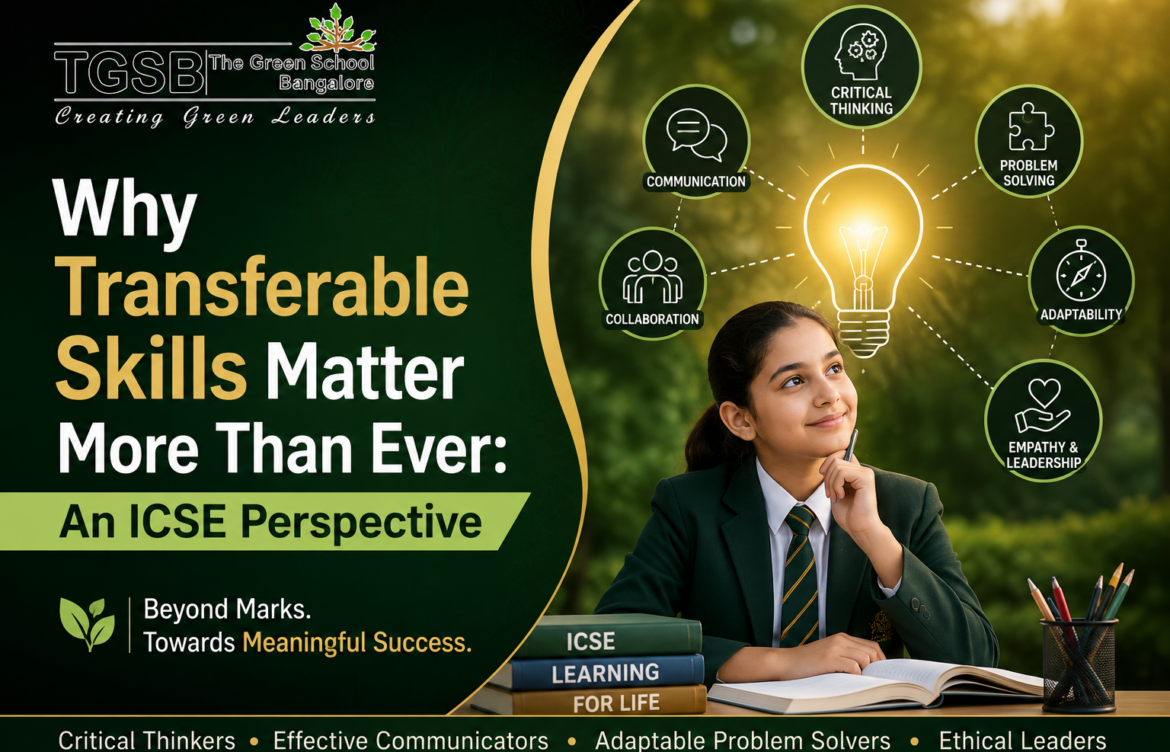
Why Transferable Skills Matter More Than Ever: An ICSE Perspective
A few weeks ago, a parent sat across from me carrying a folder full of report cards. The child had consistently performed well. Strong marks. Positive comments. Excellent academic progress. Yet the parent’s concern had nothing to do with academics.
“He knows the answers,” she said quietly. “But when things don’t go according to plan, he falls apart.”
That sentence stayed with me.
Because perhaps that is the educational question of our times.
Not whether children know enough.
But whether children can cope when knowing is not enough.
For decades, educational success was relatively straightforward. Study well. Score well. Progress well. The formula made sense because the world itself was relatively predictable. Most professions changed slowly. Information was difficult to access. Expertise was valuable because knowledge was scarce.
best icse schools in whitefiled
Today, the situation is entirely different.
A child can access information within seconds. Answers are available everywhere. Facts can be searched instantly. Yet despite living in the most information-rich period in human history, employers, universities, and communities continue to complain about something remarkably different.
People struggle to communicate.
People struggle to work with others.
People struggle to handle feedback.
People struggle when situations become uncertain.
People struggle when plans fail.
In other words, the challenge is no longer information.
The challenge is application.
This is where transferable skills become so important.
The phrase sounds technical, but the reality is deeply human. A transferable skill is simply a capability that remains useful regardless of the subject, profession, workplace, or life situation. Imagine a child who learns how to express an idea clearly in a classroom discussion. That same ability may later help them present a business proposal, resolve a misunderstanding in a relationship, negotiate during a conflict, or lead a team. The discussion may be forgotten. The skill remains.
This is why many educational conversations around the ICSE curriculum are becoming increasingly interesting. Parents are beginning to realise that the value of education cannot be measured solely by what children remember. It must also be measured by what children can do with what they remember.
A student may forget a chapter from history.
A student may forget a chemistry equation.
A student may forget a mathematical procedure.
Yet the ability to analyse information, identify patterns, communicate reasoning, challenge assumptions, and apply knowledge to unfamiliar situations often remains.
Those capacities travel.
That is what makes them transferable.
At TGSB, learning is viewed through this broader lens. Education is not simply preparation for examinations. It is preparation for participation in life. This means students are constantly placed in situations that require them to think beyond memorisation. They are encouraged to present ideas, defend viewpoints, collaborate with peers, solve real-world problems, ask questions that do not have immediate answers, and connect learning across disciplines.
These experiences matter because life itself is interdisciplinary.
A doctor requires communication.
An engineer requires creativity.
An entrepreneur requires empathy.
A scientist requires collaboration.
A leader requires self-awareness.
No profession relies on knowledge alone.
The world rewards people who can bring knowledge to life.
Perhaps this explains why so many adults can recall a teacher who believed in them, a project that changed their thinking, a challenge that tested their resilience, or a presentation that built their confidence. Rarely do they speak about the worksheet that transformed their future.
The experiences that stay with us are usually the experiences that changed how we see ourselves.
And that may be the deepest purpose of education.
Not merely helping children accumulate information.
But helping them become capable human beings who can navigate complexity, uncertainty, relationships, opportunity, disappointment, success, and change.
The future will certainly continue to reward academic excellence.
But academic excellence alone may no longer be enough.
The children who thrive will likely be those who can think clearly when answers are unclear, communicate effectively when perspectives differ, adapt when circumstances change, and continue learning when the world evolves around them.
Those are not future skills.
Those are life skills.
And unlike marks, they do not expire.