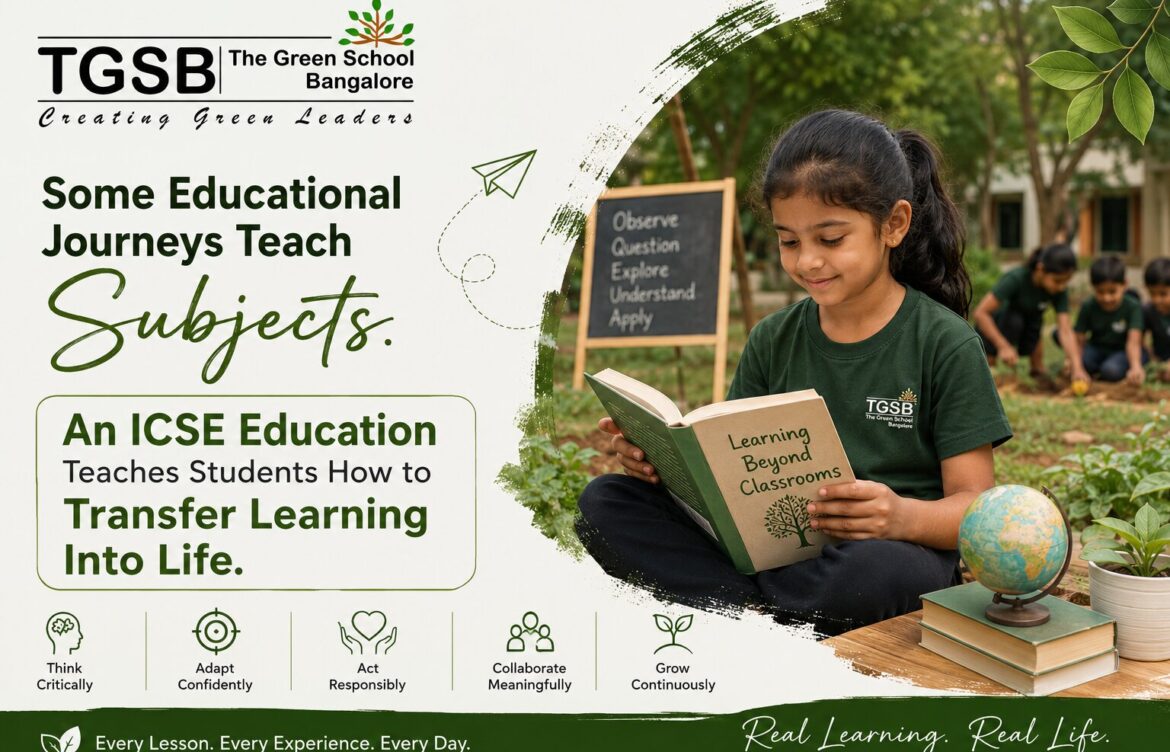
Some Educational Journeys Teach Subjects. An ICSE Education Teaches Students How to Transfer Learning Into Life.
*”The ultimate purpose of education is not to fill a mind, but to prepare a human being.”*
A few months ago, I overheard a conversation between two parents waiting outside a school gate.
One parent was anxious.
The other was thoughtful.
“My son scored very well,” the first parent said.
Then came a pause.
“But honestly, that’s not what worries me.”
The second parent looked surprised.
“What worries you then?”
The answer arrived almost immediately.
Best ICSE school in Whitefield
“I don’t know if he knows what to do when things don’t go his way.”
The conversation ended there.
But the question did not.
Because perhaps that is the educational question of our times.
Not whether children can answer questions.
But whether children can handle situations.
Think about adulthood for a moment.
How many times has life asked you to calculate the area of a trapezium?
How many times has life asked you to define osmosis?
How many times has life required you to recite a perfectly memorised answer from memory?
Sustainable schools in Bangalore
Probably very few.
Yet life asks other things every single day.
How do you make a decision when there is no obvious answer?
How do you work with someone who disagrees with you?
How do you communicate an idea so clearly that others understand it?
How do you recover after failure?
How do you respond when the plan collapses?
How do you adapt when circumstances change unexpectedly?
How do you continue learning when nobody is teaching you?
These are not examination questions.
Yet they may be the most important questions a person ever answers.
This is why the educational conversation is changing.
For generations, success was often defined by information. The student who knew more was considered better prepared. This made perfect sense in a world where information was scarce. Knowledge had enormous value because access to knowledge was limited.
Today, however, information has become abundant.
A student can access explanations, facts, tutorials, articles, and answers within seconds.
Knowledge remains important.
But knowledge alone is no longer enough.
Increasingly, the advantage belongs to those who know how to use knowledge.
And that is a very different thing.
Knowing is important.
Transfer is powerful.
The distinction matters.
A student may learn persuasive writing in English.
Years later, that same student may use those skills during a university interview, a job presentation, a business proposal, or a difficult conversation.
A student may learn data interpretation in Mathematics.
Years later, that same student may use those skills to analyse investments, understand healthcare statistics, evaluate research, or make informed decisions.
A student may learn scientific inquiry in a laboratory.
Years later, that same student may use the same habits of questioning, investigating, and evaluating evidence to solve problems in entirely different fields.
The subject changes.
The skill remains.
The chapter ends.
The capability travels.
This is what educators call transfer.
Life simply calls it being prepared.
Perhaps this is why many educational conversations are beginning to look differently at the ICSE curriculum.
The strength of an ICSE education is not merely that students study subjects.
Every school teaches subjects.
The deeper question is what students are learning beneath those subjects.
When students write extensively, they are not simply learning English.
They are learning how to organise thoughts.
How to communicate ideas.
How to persuade.
How to express themselves clearly.
When students investigate a scientific problem, they are not simply learning Science.
They are learning how to think.
How to question.
How to test assumptions.
How to evaluate evidence.
When students analyse historical events, they are not merely learning History.
They are learning perspective.
ICSE schools in Whitefield
Judgement.
Interpretation.
Context.
The subject becomes the vehicle.
The capability becomes the destination.
At TGSB, this distinction matters.
Because education is not viewed as preparation for the next examination.
It is viewed as preparation for the next decade.
And the decade after that.
The objective is not simply to produce students who can perform.
The objective is to nurture learners who can think independently, communicate confidently, adapt intelligently, and continue learning long after formal schooling has ended.
This becomes especially important when we consider the world our children are entering.
Nobody knows what the job market will look like in fifteen years.
Nobody knows what technologies will dominate.
Nobody knows which industries will transform.
Yet there are certain human capacities that remain consistently valuable regardless of time, technology, or profession.
The ability to think critically.
The ability to communicate effectively.
The ability to learn continuously.
The ability to collaborate productively.
The ability to adapt confidently.
The ability to solve problems creatively.
These capacities have survived every technological revolution in history.
They remain valuable because they are deeply human.
And perhaps that is what parents are really investing in when they choose a school.
Not simply a curriculum.
Not simply a board.
Not simply a syllabus.
They are investing in a way of thinking.
A way of approaching challenges.
A way of engaging with the world.
Because one day the report cards will be stored away.
The examinations will end.
The textbooks will be forgotten.
What remains is the person education helped shape.
And ultimately, that may be the most important educational outcome of all.
Not what a child knew.
But what a child learned to do with what they knew.+-